Plano Pet Care
How to Potty Train a Dog: A Calm, Practical Guide for Plano Pet Parents
Potty training works best when your dog has a clear routine, close supervision, immediate rewards, and calm cleanup when accidents happen.
Potty training a dog is one of those tasks that sounds simple until you are standing in the hallway at 6:15 a.m. with paper towels, a half-awake puppy, and the creeping suspicion that the dog is training you. The good news is that house training is very learnable. The less-good-but-still-manageable news is that it requires consistency from the humans.
Whether you have a new puppy, an adopted adult dog, or a dog who needs a refresher after a move, potty training works best when the rules are clear and the routine is predictable. Dogs are not trying to be stubborn or spiteful when they have accidents. Most accidents happen because the dog had too much freedom too soon, the schedule was unclear, the owner missed a signal, or the dog physically could not wait.
At La Pawz Dog Care in Plano, we see the same pattern across grooming, boarding, daycare, and training: calm repetition builds confidence.
Start with the right mindset
Potty training is not about catching your dog doing something wrong. It is about setting your dog up to be right as often as possible.
Your job is to make four things obvious: where to go, when opportunities happen, what reward follows success, and what calmly happens after a mistake.
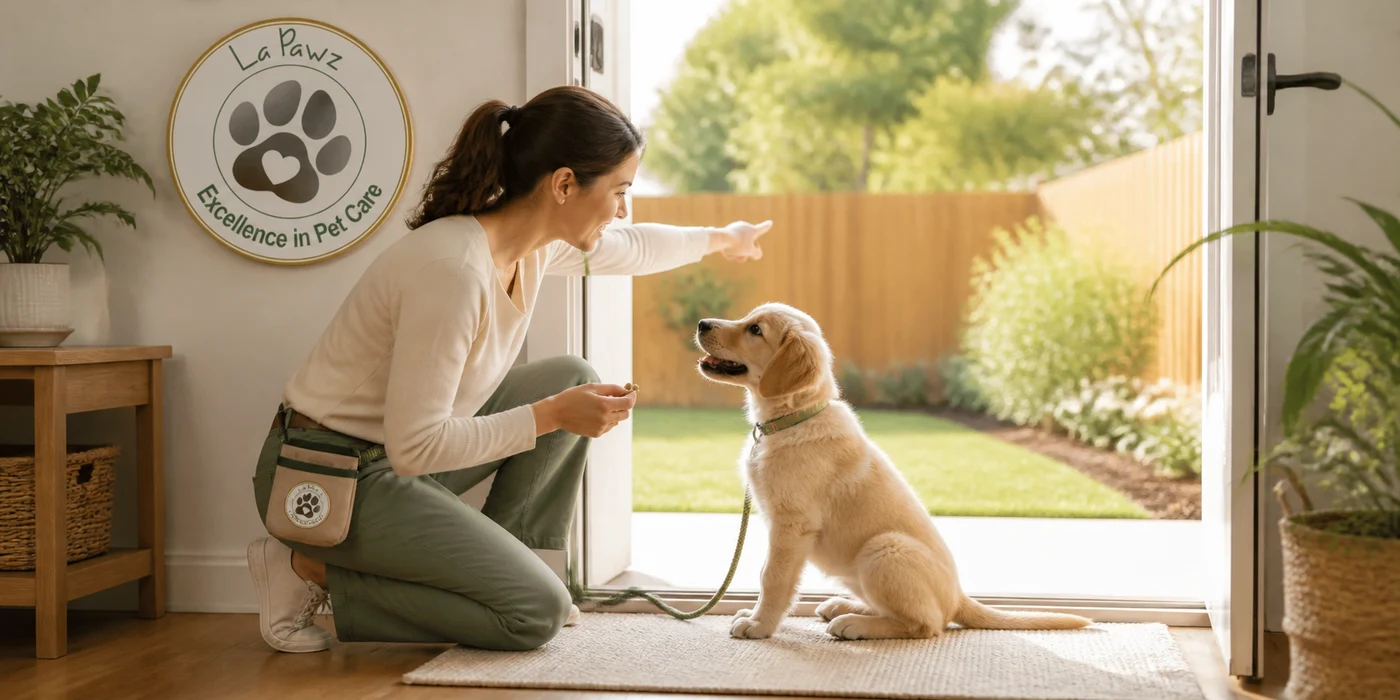
Pick one potty location, whether that is a backyard area, a grassy apartment spot, or a designated indoor potty area. Use the same door, route, and cue phrase whenever possible. “Go potty” is enough. Dogs are better with patterns than paragraphs.
The UC Davis School of Veterinary Medicine explains that puppies lack the developed bladder control adult dogs have, which is one reason frequent opportunities matter. A young dog may understand the goal before their body can consistently meet it.
Build a predictable schedule
The schedule is the heart of potty training. Most dogs need a potty break at key transition moments:
- First thing in the morning
- After meals
- After drinking
- After naps
- After active play
- After time in a crate or pen
- Before bedtime
- Anytime they sniff, circle, whine, pace, or suddenly disengage
For puppies, frequent breaks are normal. The American Kennel Club gives a common guideline that puppies may be able to control their bladder for roughly the number of hours matching their age in months, up to around 9 months to a year, but every puppy is different. A three-month-old puppy may need a chance every few hours, and exciting play can shorten that window dramatically.
Adult dogs usually have more physical control, but they still need a routine while learning a new home. Adopted dogs may also need time to understand the layout, door, yard, surfaces, sounds, and expectations.
If you are unsure where to start, take your dog out often during the first week. It is easier to reduce extra trips after success than to undo indoor accidents.
Reward immediately, not eventually
The reward must happen right after your dog finishes in the correct place. Not when you get back inside. Not after you find the treat bag. Right there, within a second or two.
Use cheerful praise, a small treat, or a short moment of play. Keep it warm but not so exciting that your dog forgets what they were doing. The goal is simple: “When I potty here, good things happen.”
If your dog does not go, do not turn the trip into a backyard party. Wait calmly for a few minutes. If nothing happens, bring the dog back inside and supervise closely, or use a crate or safe confinement area briefly, then try again. This prevents the classic “played outside, pottied inside” pattern.
Supervision prevents most accidents
When a dog is learning, freedom is earned gradually. A dog who is not potty trained should not have full access to the house. That is not punishment; it is clarity.
Use baby gates, a pen, a leash attached to you, or a crate when you cannot actively watch. Close bedroom doors, block favorite accident spots, and keep your dog nearby so you can notice early signals.
Common potty signals include:
- Sniffing the floor
- Circling
- Wandering away from the family
- Standing near the door
- Whining
- Sudden restlessness
- Returning to a previous accident area
The earlier you respond, the better. Once your dog is already squatting, the lesson becomes harder. If you catch your dog in the act, interrupt gently with a calm “outside,” then take them to the correct place. If they finish there, praise and reward.
Use a crate or safe space kindly
A properly introduced crate can be a helpful potty-training tool because many dogs prefer not to soil their sleeping space. The crate should be large enough for your dog to stand, turn around, and lie down comfortably, but not so large that one corner becomes a bathroom.
Crate time should be paired with comfort, not fear. Add safe bedding if appropriate, provide a chew or toy, and build positive associations slowly.
If your dog repeatedly soils the crate, pause and reassess. The crate may be too large, the dog may be left too long, the schedule may need adjusting, or there may be a medical or stress-related issue. Dogs with diarrhea, urinary tract problems, anxiety, or a history of long confinement may need a different plan and veterinary guidance.
Clean accidents thoroughly
Accidents are information, not moral failure. Clean them well and adjust the plan.
Use an enzymatic cleaner made for pet urine and stool. Regular household cleaners may remove the visible mess but leave odor signals behind. Dogs have powerful noses, and lingering scent can tell them, “This is the bathroom.”
Avoid yelling, scolding after the fact, or rubbing a dog’s nose in a mess. Those reactions do not teach the dog where to go. They can teach the dog to hide accidents from you. The AKC and veterinary behavior sources consistently emphasize calm cleanup and positive reinforcement over punishment.
After an accident, ask:
- Did the dog just wake up, eat, drink, or play?
- Was I watching closely?
- Was the dog given too much space?
- Did I wait too long between trips?
- Is this happening at the same time each day?
- Could there be a medical issue?
Then make the next 24 hours easier: more supervision, more frequent breaks, and faster rewards outside.
Potty training adult dogs
Adult dogs can absolutely learn new potty habits. In fact, some adults learn faster than puppies because they have better physical control. Start as if the dog is new to the idea, even if you were told they were previously house trained.
Moves, schedule changes, new flooring, new smells, stress, boarding transitions, and household changes can temporarily disrupt habits. Show the dog the potty area immediately when they arrive home. Reward outdoor success heavily for the first several days. Keep the home routine simple until your dog understands the new pattern.
If an adult dog who was reliably house trained suddenly starts having accidents, call your veterinarian. Urinary issues, digestive problems, pain, mobility changes, cognitive decline, medications, or stress can all affect elimination habits.
Handling rainy days, Texas heat, and busy schedules
North Texas weather adds its own flavor to potty training. Some dogs object to rain. Some hesitate on hot pavement. Some get distracted by wind, squirrels, landscapers, or every leaf in Plano.
Keep trips short and purposeful during uncomfortable weather. Use a leash even in a fenced yard so you can guide your dog to the potty area and reward immediately. In summer, choose shaded areas, avoid hot pavement, and go during cooler parts of the day when possible. If weather is severe, safety comes first.
For busy households, set phone reminders. Coordinate who is responsible for morning, midday, evening, and bedtime trips. Dogs learn faster when everyone follows the same plan.
A simple first-week plan
For the first week, keep the routine almost boring: outside immediately in the morning, after meals, after naps, after play, before bedtime, and anytime your dog shows potty signals. Young puppies may need one overnight trip. Keep nighttime breaks quiet and simple: out, potty, reward, back to bed.
Track patterns for a few days. Accidents often happen at predictable moments. Once you know the pattern, you can beat it.
The La Pawz takeaway
Potty training succeeds through routine, supervision, immediate rewards, and patient cleanup. Your dog is not trying to make your life harder. They are learning a household rule that only becomes obvious when humans teach it clearly.
If your dog is visiting La Pawz for daycare, boarding, or grooming, let our team know about any training routines, stress triggers, or recent changes at home. Consistent care notes help dogs feel safer across environments.
For puppy accidents that do not improve, adult dogs with sudden house-soiling, painful urination, diarrhea, vomiting, blood, extreme thirst, or behavior changes, contact your veterinarian. For everyday care, structure and patience go a long way.
Need help keeping your dog on a reliable care routine? Request an appointment with La Pawz Dog Care in Plano.